
Art, perseverance, and the war against Palestinian culture
In every heart is a hero and a coward
In every heart is a penchant for light and darkness
In every heart is a choice
Memory
I recall traveling in Palestine years ago. It was safer then, albeit still managed as an open-air prison, dotted with high walls, Israeli-manned checkpoints, and area-wide surveillance. Even shopping areas under the Souk in the old city were infiltrated by the IDF using computer screens to monitor the movement of individuals, of couples meeting informally or kids on their way to school. It was all photographed and analyzed real-time, minute-to-minute.
The oxygen of freedom was scarce. Yet, out of this military control and suffocation, Palestinians developed a unique culture of hope through art. They practice the uniquely human ability to create meaning and beauty out of pain and rubble. Art helps Palestinians prevail against brutality and the ongoing attempts to eliminate their identity. Their creations are as essential to their spirit as the life force that drives a flower to seek sunlight through a crack in the cement or asphalt.
Palestinian art is little known in the West. It is omitted from universities, museums, or public venues. It’s like a bard trying to bear witness and truth to fellow humans only to be shut out. Perhaps this is a cultivated amnesia or well-planned refusal to exclude art with communicative power. Art in the West has increasingly become a commodity, like a polished stainless-steel rabbit that sold for millions of dollars, and paintings given value by collectors or auction houses.
The IDF knows that art inspires and connects people. And so, they have targeted the very essence of Palestinian culture. The beauty of art lies in its transcendence beyond the rubble of everyday life. The echo of this value is captured in a well-known incident which occurred in fascist Spain prior to the outbreak of World War II. A German soldier reportedly stood in front of Picasso’s “Guernica”, which depicts a graphic scene of bomb-related death and chaos and demanded to know, “Who created this?” Picasso responded, “You did.”
The IDF, according to various local sources, has killed 50 prominent writers and 30 painters while bombing 32 cultural centers and 12 museums in Gaza alone. Art galleries are regularly targeted to ensure that art doesn’t inspire anyone to question Israel’s occupation. The watermelon has long been a symbol of that defiance with its red, green, white and black mirroring the colors of the banned Palestinian flag. A painted canvas of a sliced watermelon in a gallery window was smashed by Israeli soldiers. Even a symbolic image remains dangerous.
IDF destruction of art galleries recall Kristallnacht or Night of Broken Glass, carried out by Nazis against Jewish store owners in Germany, November 9, 1938. Israel has perfected war against Palestinian artists and symbols which are often mirrored in the West by exclusionary practices including canceled lectures and algorithmic suppression of pro-Palestinian content on social media via Meta. Israel, in order to fan the flames of injustice, has also taken to projecting the Israeli flag and colors onto Hebron’s Ibrahimi Mosque (Aljazeera, May 21, 2026).
Following are highlights of courage—artistic actions—whereby artists risk imprisonment or death. Palestinian art, in Gaza and the diaspora, doesn’t imitate life, it creates, and sustains it.
Artists
Professor Alareer
Refaat Alareer was a Palestinian writer, poet, and professor of English literature. He captured the ever-present threat to life in Gaza in his elegant poem, “If I Must Die”, written November 27, 2011. It was pinned to his Twitter profile on November 1, 2023—five weeks before his assassination.
If I must die,
you must live
to tell my story
to sell my things
to buy a piece of cloth
and some strings,
(make it white with a long tail)
so that a child, somewhere in Gaza
while looking heaven in the eye
awaiting his dad who left in a blaze—
and bid no one farewell
not even to his flesh
not even to himself—
sees the kite, my kite you made, flying up above
and thinks for a moment an angel is there
bringing back love
If I must die
let it bring hope
let it be a tale
Professor Alareer was assassinated by an Israeli airstrike directed at his sister’s apartment where the family was sheltering on December 6, 2023. He was 44 years old and died alongside six members of his family.
Lina, friend and colleague (last name withheld for safety)
Lina’s house was bombed into rubble by the IDF. At night, when the IDF patrols her neighborhood and sirens pierce the night, she covers her baby with her body and pillows to protect her from shrapnel. She currently lives with her family in what remains of Gaza. She wrote:
Still We Stand
From Gaza we rise through smoke and night,
still chasing a fragile spark of light.
Homes may fall, but hearts remain,
beating hope through every pain.
We speak of peace, we speak of land,
with broken hearts and trembling hands.
Yet still we stand, we will not fade,
for truth is stronger than the blade.
Mahmoud Darwish
Mahmoud Darwish is Palestine’s national poet and author of the Declaration of Independence. He wrote one of the most imaginative and touching poems reflecting his imprisonment nine times by the IDF for reciting his poetry in public. Later, Israel refused to honor his last request which was to be buried next to his mother’s grave site.
The Prison Cell
It is possible . . .
It is possible at least sometimes . . .
It is possible especially now
To ride a horse
Inside a prison cell
And run away . . .
It is possible for prison walls
To disappear,
For the cell to become a distant land
Without frontiers:
What did you do with the walls?
I gave them back to the rocks.
And what did you do with the ceiling?
I turned it into a saddle.
And your chain?
I turned it into a pencil.
The prison guard got angry.
He put an end to the dialogue.
He said he didn’t care for poetry,
And bolted the door of my cell.
He came back to see me
In the morning.
He shouted at me:
Where did all this water come from?
I brought it from the Nile.
And the trees?
From the orchards of Damascus.
And the music?
From my heartbeat.
The prison guard got mad.
He put an end to my dialogue.
He said he didn’t like my poetry,
And bolted the door of my cell.
But he returned in the evening:
Where did this moon come from?
From the nights of Baghdad.
And the wine?
From the vineyards of Algiers.
And this freedom?
From the chain you tied me with last night.
The prison guard grew so sad . . .
He begged me to give him back
His freedom.
Hussein al-Jerjawi
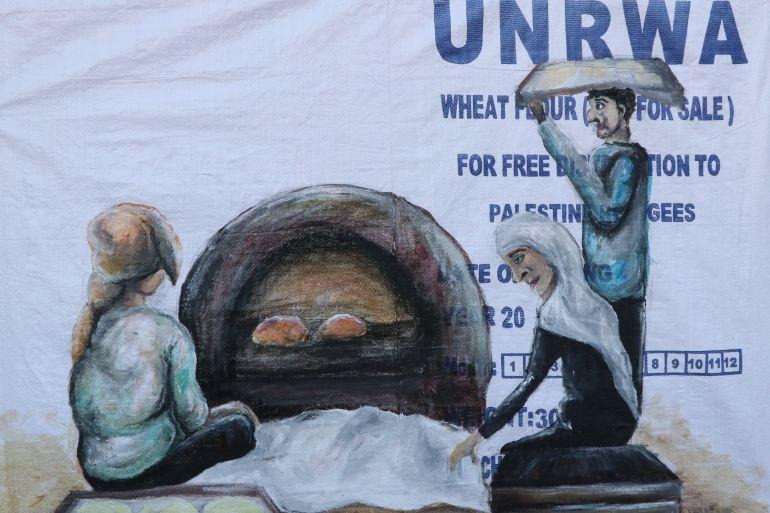
For many impoverished artists there is no canvas available for them to express themselves, so they revert to materials they can scavenge. Hussein al-Jerjawi uses empty UNRWA flour bags as canvases for his artwork depicting everyday life in Gaza [Courtesy of Hussein al-Jerjawi], pictured below. He survives in Gaza today.
Hiba Abu Nada
Hiba Abu Nada, a poet and novelist, was murdered in an Israeli airstrike in Khan Yunis in October 2023. Air strikes vaporize individuals. She was 32.
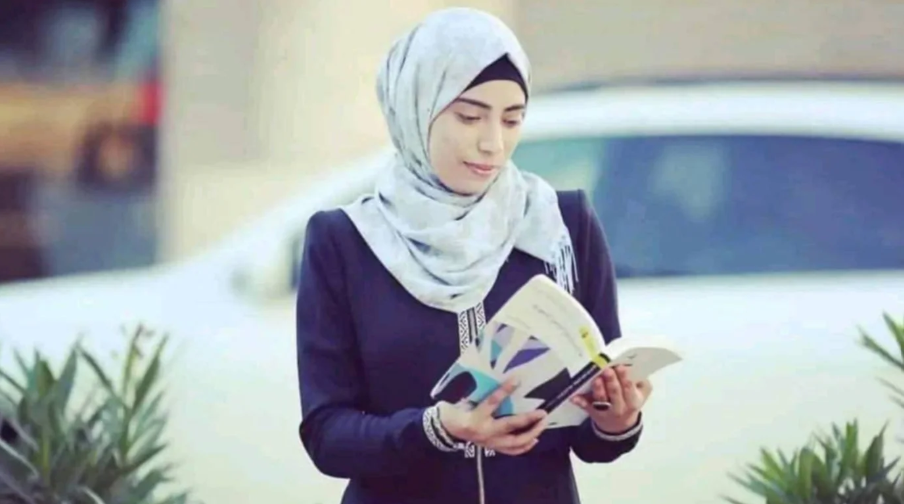
Her last poem was shared on X, formerly Twitter, just a few days before her death:
“Gaza’s night is dark apart from the glow of rockets,
quiet apart from the sound of the bombs,
terrifying apart from the comfort of prayer,
black apart from the light of the martyrs.
Goodnight, Gaza.”
Heba Zagout
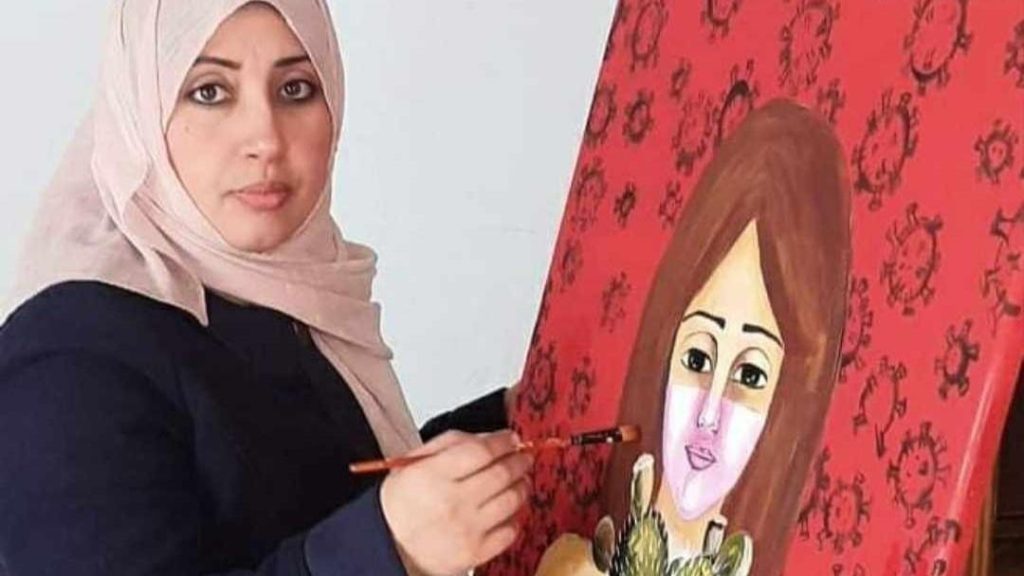
Visual artist and fine arts educator Heba Ghazi Ibrahim Zagout, aged 39, and two of her four children were murdered in an Israeli bombing on October 13, 2023. In the days leading up to her death, she recorded a video showcasing her paintings and passionately discussing her works, expressing her dream of organizing an art exhibition to share her creativity.
Diaspora
Samia Halaby
Ms. Halaby was born in Jerusalem, in what was then Palestinian territory, in 1936 and is based in New York. Her childhood home was taken by Israel in 1948. Hundreds of thousands of Arabs were displaced and their lands stolen in what later became known as the Nakba.
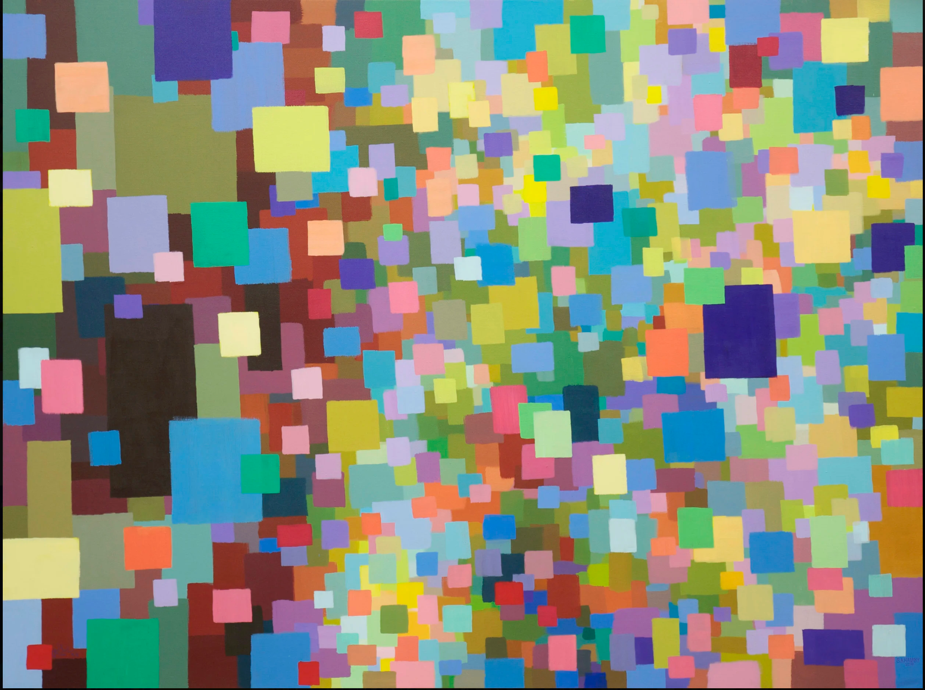
Halaby for much of her career has turned to nature for inspiration; the dance of color, light, balance and movement fascinated her. Not long ago, a scheduled major retrospective of her artwork at Indiana University was abruptly canceled by the administration to avoid conflict. The choice between freedom of expression and political expedience was made in favor of expedience. She had taught art classes at the university for years. Her painting below is entitled Green Earth.
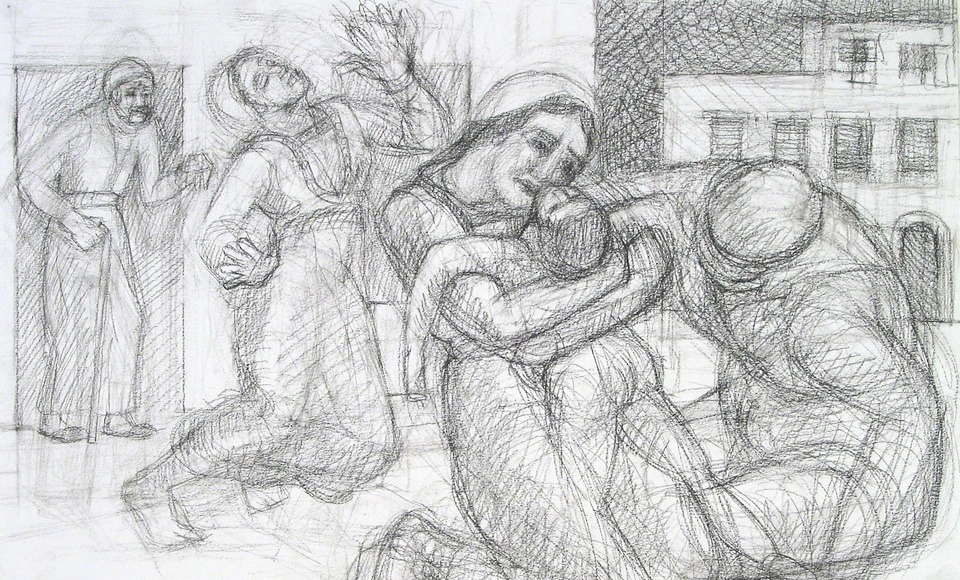
Halaby has also completed art works that bear witness to history in the tradition of Picasso, and Käthe Kollwitz. She spent twenty years studying and documenting the massacre that occurred at Kafr Qasim on October 29, 1956. An Israeli military commander imposed a sudden, arbitrary curfew on this town of 1,500 Muslim residents. The Israeli border police were told to shoot to kill any person outside their home after 5pm—make no distinctions. The police, following orders, killed 49 men, women and children who were not privy to the curfew because they were returning from working in the fields—on foot or bicycle, many tending olive trees. The police then buried the bodies while the victims’ relatives were still under curfew. When the curfew was lifted there was no evidence of bodies, which was only revealed later under investigation. All of the victims were Arab-Israeli citizens.

Hope
The war and genocide in Gaza have influenced a generation of artists, fostering dialogue and expression between Palestinians and Israelis. Some art programs are bringing both nationalities together to witness and craft creative responses to turmoil and death. In a shared residency at Givat Haviva, for example, ten Arab and Jewish artists reflect on co-existence, creativity and artistic freedom. All students worked in a shared studio. The practice of art itself built bridges between students exploring issues such as censorship, independence from family, memory, the deeper meaning of fishing in biblical terms and what has struck some Jews as provocative verse by Darwish. The students agreed that the war and its impact applied to other victims and children in the region too. Art programs in the U.S. would do well to follow this model of learning.
All of these activities provide hope and are a welcome thaw from Israel’s right-wing, genocidal government under Prime Minister Netanyahu, and its counterpart under President Trump. Art will not be silenced by war, adversity or poverty. It is the one practice that deepens our humanity and communicates hope beyond borders and time. In every heart there is a choice.
This is a powerful statement about Israel’s mistreatment of Palestinian. It is a unique approach.
Israel’s military “solution” to murderous Iranian-supported groups is probably just what our own Defense Secretary would do.