
Our God
America has a god. It’s neither he nor she nor the other. Neither white or black. Neither Christian, Jewish, Buddhist or Muslim. It crosses social classes. It’s the most powerful god in human history. It makes worshiping the Golden Calf in the Bible appear as a value worth pursuing, not a warning. Our god is the God of Accumulation, and its twin, consumption.
Americans love to accumulate things, which drive consumption. We accumulate money, houses, cars, closets full of clothes, adornments, travel points, grocery points, likes, loves, friends on social media, news stories and serial mates; men, women, and all combinations thereof. Swipe right or left and get lucky; or accumulate an entire database of potential friends.
The storage industry is a testament to accumulation. Americans are driving an industry worth an estimated $72 billion. We buy things, use them, get bored with them and want something new; we buy more things, and then store them. Or, we try to resell items in thrift shops, second hand stores, garage sales, church sales, online, or in warehouses. It all amounts to the same pattern, accumulate, sell, store and replenish. Start again.

We spend our leisure time accumulating as well. The average American woman, for example, makes over 300 trips to the store, and spends close to 400 hours shopping annually. This amounts to an estimated 8.5 years spent shopping during a typical lifespan.
The newest form of accumulation is experience. Get your travel card and take off. Recollections of trips include, new experiences, ‘the food and shopping were great’. Individuals can be heard saying, ‘I can’t believe how cheap it is’, ‘I got a great deal on my leather jacket’, ‘my earrings, my shoes, my painting’; and, ‘by the way, the people were friendly.’
Social status
Within a few minutes of meeting an American, after saying hello, you get a quick snapshot of how well they have done in playing the accumulation game– where they live, and what they own; houses, condos, timeshares, rental property, farms, ‘my Tesla is in the shop’; ‘my house in Cabo is in need of gardeners’; ‘I own rental properties in Medellin, and Mexico.’ I don’t even need to ask anything about them. They vomit what they own. Their Accumulation Score is a central part of their identity.
The practice of accumulation also affects our communication. This form of communication is primarily transactional, not relational. Transactional communication is instrumental and efficient. It is data rich. Ask an American, ‘how are you’ and the response is frequently a cut to the chase ‘fine’, ‘ok’, ‘not bad’; and you? It parallels please check your response to our service—fine, ok, not bad, needs work. It is the language of commerce.
If you want to know someone’s social status—they’re Accumulation Score— just ask them the question, where are you from? South Beach, Miami, New York, West End, and for sure, Martha’s Vineyard, or Marin, on the hill nearby. Qualifiers like ‘live on the water’, ‘or the hills above’, or ‘in a gated community’, score high. Accumulators sit on ‘wrap around decks with a view’, while others sit on ‘porches’ looking at the street.
American psyche
The value of accumulation is anchored so deeply in the American psyche that the only people not mesmerized by it are infants for the first 1.5 years of life, outsiders and freaks. Infants need milk to survive, Americans need credit cards. Without easy access to securing credit online, at your bank, at checkout, and the ability to grow debt, rates of psychological depression and rage would skyrocket beyond already high levels.
Americans depend on being able to buy now, pay later to feel normal. People are maintaining goods and services. American households have a total debt of approximately $18 trillion, over $105,000 per each household. Auto loans account for over $1.6 trillion, credit card debt is over $1 trillion, and mortgage debt makes up only 70 percent of the total. The higher the education level, the greater the debt. One third of Americans are in trouble with credit card payments. Debtors Anonymous has grown steadily for over 21 years, and is now available on zoom.
In the early stages of American capitalism, individuals paid cash for items they wanted. That evaporated sixty years ago. Then came the two income family, which was critical to increase one’s standard of living, or one can read the level of debt. This standard was measured by accumulation of material goods. Everything got bigger. Bigger houses, cars, boats, and cruise ships. Even people. The size 12 dress became the new size 10; waistlines expanded by two inches. Homer Simpson, and Family Guy, feature obese characters. They draw audiences of 1.5 to 2 million viewers per episode; for years. Fatsos are a big draw. Why? It’s evidence that accumulation is working. Cheesecake Factory, known for large portions, can’t make their portions any bigger or they would need to upsize their plates.
This increased standard of living has left a paper trail of sizable debt; individual, household, and national debt. The U.S. is essentially insolvent, financed by other countries who invest in our debt. The American economic success story is running a deficit of $36 trillion. Wall Street, however, loves debt. Loan to own is a popular saying. Our political leaders avoid addressing the real causes of our national debt because it has tax implications, and might dent their lifestyle. They are accumulation addicts too.
Trump & corporations
Politics.
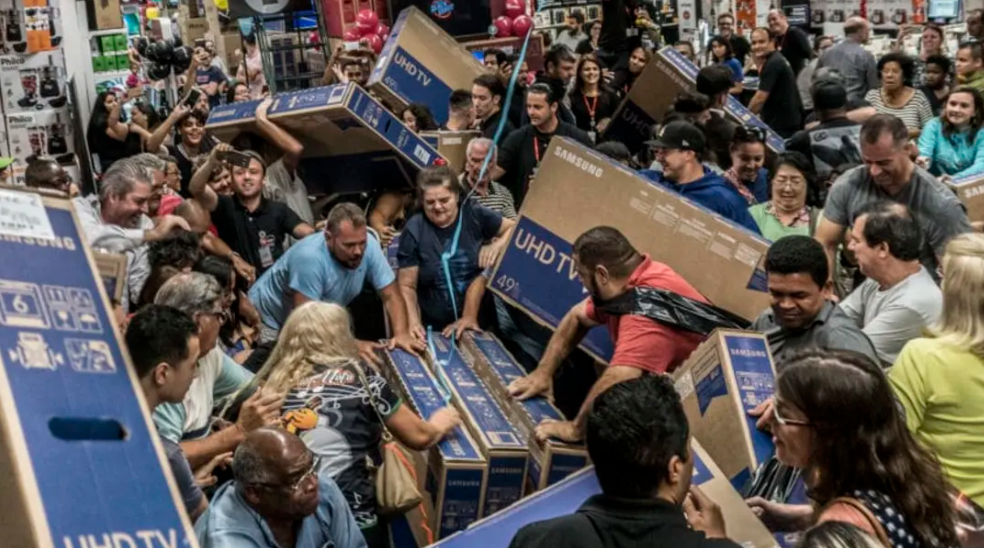
The God of Accumulation got Trump elected. Trump, a 270 pound obese, convicted criminal, simply accused Democrats of tampering with the God of Accumulation. As soon as you combine populism with the promise of increasing an individual’s ability to accumulate things and self-worth, you have a symbolic pitch that’s hard to beat. After all, freedom to most Americans is captured in Black Friday, $36 billion dollars spent in 24 hours. By comparison, this is more than double the amount spent in 2017, while household incomes of average Americans have been falling steadily over the last 17 years.
Corporations are in on the accumulation game too. They want a free ride to accumulate as much cash as they possibly can at little or no cost. They accumulate money, materials, code, land, and everything else on the globe, and pay little or nothing for it. No payment for environmental damage and less payment for labor is their ideal. Corporations sponsor the same political representatives that espouse no taxes on income. Taxes have a negative impact on, you guessed it, accumulation.

Trump, Elon Musk and Republicans are conducting a giant ruse. They are touting the economics of slash and burn to reduce government debt. More accurately, social and medical programs. Unfortunately, no one seems to know the details of what the real financial problems are, or the impact of their strategies. Consider that a 10% reduction in Pentagon and military spending for one year would save us over $80 billion alone. Reduction in military spending is the one strategy that you will hear little about. The Gods of Accumulation are happy to capitalize on military spending and destruction. Blow things up, then, rebuild them; repeat. Tax the rich to pay their fair share, forget it. Our representatives are bought.
In our system of accumulation, capital floods up, disappears down. Billionaires added $2 trillion to their wealth in 2024, equivalent to roughly $5.7 billion a day, three times faster than the year before. In twelve months, billionaire wealth surged from $13 trillion to 15 trillion. Interest in America’s accumulation and debt problem seem limited at best.
Conclusion
Forget balanced budgets. Too late for that. Forget slash and burn of government departments to save money. The amounts saved won’t make any real difference in the short and long run. Here’s an idea that will solve the problem: tax everyone making over $500,000 annually, at the rate of 40 percent on any, and all income generated locally, and globally; tax asset appreciation at 20%; tax capital gains at 30 percent and effect a flat corporate tax globally of 30 percent. Tax all internet sales at 15 percent. These actions will eliminate the deficit within 5 years. However, it might prove to be unpopular.
Postscript
No leader or representative in government or corporations today really wants to solve the addiction to accumulation or deficits problem. Keep buying, keep trying as I say.
Yes, we worship Mammon. Remember George H.W. Bush, after 9/11, telling Americans to go out and buy? How about Trump today, using the White House to huck Musk’s Teslas? Janet can tell you how I began my first marriage with a ledger of each expenditure. Over the top, but it shows my retort to consumerism.
Keep enjoying your financially balanced life in Medellin. Love, Phil
our status seems to be very important measured by consumption. Also we are a depressed culture feeding ourselves with things – stemming form the lack of attachment in formative years.
Buying brings momentary happiness, to unfilled lives.
Well, I am convinced that things have gone to hell. Your analysis of our current situation regarding money and accumulation is certainly right on target. The solution will be
elusive for us, because our habits are ingrained and our denial is robust. Wish it were otherwise.