
America has a long tradition of conmen. Today’s conmen can be found throughout positions of political and technological leadership. It’s time for the Con Man Awards; featuring the creativity and history of the conman, and the sometimes happy victims.
Origins
I imagine a new category of awards in contemporary history. The Time Man of The Year is replaced by the Con Man Awards. Conmen have a long history in America from which to generalize. From the beginning of the country, they inhabited cities and rural towns alike. They sold snake oil to cure disease, utilized gambling schemes to fleece travelers on Mississippi steamboats, and transferred real estate in which they had no ownership. White settlers prided themselves on trading beads with Native Americans for Manhattan Island.
Herman Melville, the great American writer, brought the character of conmen to attention through his 19th century novel, The Confidence Man: His Masquerade. Confidence men, he wrote, have a unique ability to gain the trust of others while lying and stealing from them. They make misrepresentation an art.
Psychologically, conmen share common characteristics including heightened self-confidence in the truth of whatever they are promoting; uncanny ability to convince others that they have their best interests in mind; sales oriented personality, reassuring their ‘mark’ while swindling them; and sociopathy, demonstrating no regard for the other person’s loss. Individuals who fall for their pitch are secretly perceived as stupid. It was their own fault.
Innovation
Conmen leadership roles took on a grand scale in Hitler’s ‘Third Reich’. Joseph Goebbels, minister of propaganda, utilized the transistor radio, a new technology at the time, to reach a mass audience promoting the political line ‘make Germany great again’. Goebbels, who held a doctorate in philology, was a master at crafting narratives, and metaphors to motivate people to commit atrocities in the name of doing good for Germany. He used hyperbole, like ‘total war’ to inspire people, at the point where it was clear that Germany was losing the war. Lying, to Goebbels was an art, the bigger the lie, the more likely the population was to believe it.

Television and social media are the vehicle of promotion today. Targeted narratives, signs, symbols and character development, no matter how fake, inform media. What has changed over the years, is the application of behavioral and cognitive science to engage people and manipulate their thinking in ways never thought possible. Our capacity for misrepresentation has been amplified exponentially through neuro-directed, technologically enhanced channels formatted for lying.
Social media, for example, lends itself perfectly to hyper-segmentation of audiences, testing, retesting, and altering messages real time, while manipulating images to match thoughts and motivate behavior. This technology is reflexive, and relatively inexpensive to tailor to individual audiences. No Nielson reports or traditional market statistics with time delays are required to win the hearts and minds of individuals. From cognitive framework to teleprompter to managed perception, a highly personalized universe of beliefs is created and reinforced.
While the con man relies on a keen intuitive sense, like days of old, today he/she is trained to communicate a pitch honed by a laboratory of techies, behavioral scientists and makeup artists. It is a carefully orchestrated spectacle, filling 24-hour media channels with ‘news’. It takes talent and method to craft these messages and promise social and economic solutions to problems, with little basis in personal capabilities, data, causality or reality. The power of new media can create relationships and alter perceptions’ real time without any reference to actual data; data and facts are only sidebars to sales and promotion.
Individuals now discount or are immune to facts, reducing them to personal opinions that are reflected in the con man. Personal opinion, in spite of facts, or reality to the contrary, have become a self-righteous calling of ‘truth’—like Trump’s media channel, Truth Social. Individuals are convinced that the personal opinion of the con man holds the answer to their problems.
Nominees for top conmen
Donald Trump is my first nomination for top con man. Mr. Trump has created a populist image second to none. In spite of selling phony real estate diplomas, multiple felony convictions, roughly 3,000 law suits, and a number of rape charges by victimized women, he has convinced a majority of voters that he is going to Make America Great Again. He is, after all, like any working class person who is getting a raw deal by a society that is against them. He is on ‘your side’, defined as increasing purchasing power without limits; and condemning illegal immigrants—rapists, drug users, and killers– flooding the country daily. Trump is here to provide security and protect us all. He’ll drain the swamp all over again.
Elon Musk is my second nomination. Mr. Musk, billionaire entrepreneur, is selling us on making government more efficient, eliminating entire departments, perhaps the department of education, climate related departments, persons and functions, and anything else that stands in his way. He despises limits, and provides a majority of Americans with a character that they can identify with; an immature adolescent with wealth and power who can behave any way he/she wants. There are no adults allowed in the room to hold him accountable.
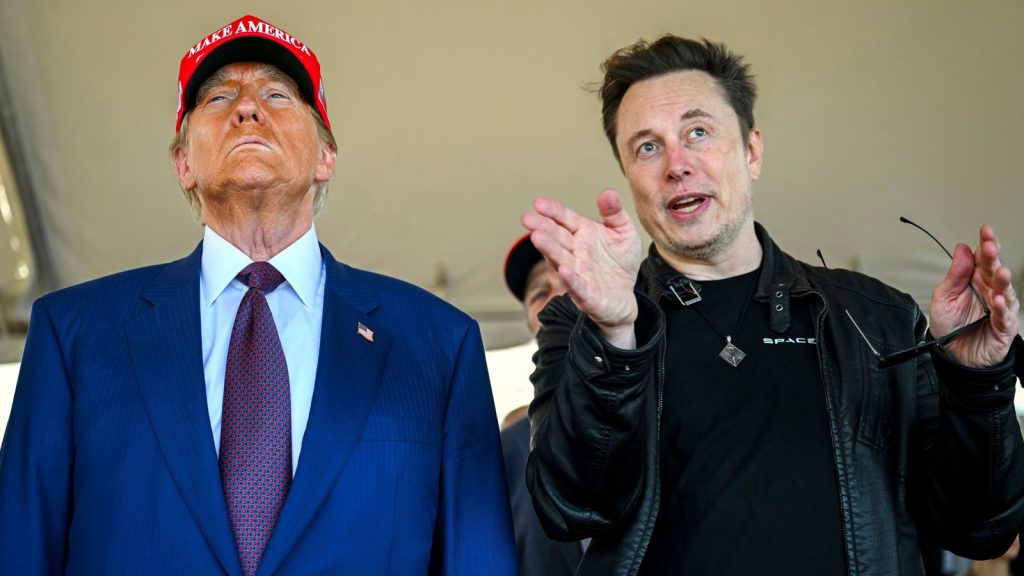
As a crusader with adolescent behavior, he doesn’t need to study issues, review protocols, or discover rationales for government departments or people. He just needs to create the narrative ‘less government means efficient government’, and launch the program.
Perhaps it never occurred to his followers that his business interests in media, space travel, autos, and brain implants, are all heavily regulated, and have depended on tens of billions of dollars in government loans. Since Trump’s election, Musk’s net worth has increased by 25%, or $64 billion. Less regulations mean billions of dollars more in his bank account, and more risk for citizens.
Tesla, for example, cannot compete effectively against Chinese electric cars, which offer better performance at lower cost. Slapping tariffs on Chinese autos only enables an inferior product to dominate local markets. Musk has a clear conflict of interest. Tesla, for example, borrowed $465 million dollars from the U.S. government in 2010 to launch a production facility in Fremont, California. Musk is now considering blocking loans granted by the Biden administration to Rivian Automotive, a rival electric car company. Lack of regulations may also reduce education standards, environmental and global warming controls and safety for the planet.
Robert F. Kennedy Jr. (RFK) is a con man who relies heavily on his family name to engender trust. He uses highly personal testimonials to con people. Lately, he has proffered that he used heroin to help improve his attention span as a young person. He attributes success in studying and academic advancement to this magical substance. This is the same person who denies that vaccinations are necessary, maybe even evil, despite two hundred years of science and research to the contrary. It is probably the self-stated worm in his brain that helped him bring things together.

On the foreign scene, lastly, I would nominate Prime Minister Benjamin Netanyahu of Israel. He has convinced the world, especially the U.S., that he needed to authorize and promote the killing of over 43,000 Palestinians—-70% women and kids—-to save Israel from Hamas. No data on number of Hamas actually killed is offered. He has also overlooked—or tacitly agrees with— statements by his cabinet minister, Mr. Smotrich, that you might as well ‘kill Palestinian kids now because they grow up to be terrorists anyway’.
His humanitarian side is beginning to surface, however. After over one year of no serious negotiations or concerns for hostages taken on October 7th, he is now offering $5 million reward for every hostage returned alive. The size of this reward speaks loudly for the likelihood of hostage returns. Large populations of Israelis support this con man; they want to be conned.
Con Man antidote
It is critical to call out conmen in public and private communications; verbally, in a letter, over social media, newspaper, or street protest. The con man cannot tolerate an inkling of truth, or close approximation to it. Interestingly, in the debates for president, Trump was not once confronted by Kamala Harris to supply data and sources to back up his claims that millions of immigrants—killers and rapists—were flooding across U.S. borders. We have no idea what is true or false. This was a mistake; confrontation and data—content— are important to the quality of discourse. Conmen are charismatic, but they avoid the complexity of reality while appealing to images and metaphors. Solving genuine problems or issues facing individuals is beyond their grasp. They are motivated by the con, not the solution.
Conmen should also be compelled to provide concrete evidence of their observations and actions. Mr. Musk must be compelled to provide accurate accounts of government efficiency, what, in fact, does it mean and what are the impacts of his actions on us all. This includes clearly stating conflicts of interest, and recusing himself for advocacy or decisions that he benefits from. Importantly, a new social media channel, Bluesky, has emerged as an alternative to X.
Our leaders need to be pushed to stop participating in the con man show. The Con Man Awards should help point out who is scamming us and what to do about it. Fake is not real, and its dangerous to democracy and well-being.