
Peace is an intentional practice. History provides many proven avenues to peace and development in Israel-Palestine. The solutions are in front of us. We only need to employ them.
Beyond war and destruction
A utopian idea
Peace between Israel and Palestinians seems almost utopian. Yet, history offers us many examples of individuals and states overcoming the worst crimes against humanity. Consider, for example, the resolution of World War II whereby Germany, which killed 6 million Jews, became a major trading partner and ally of Israel; the elimination of apartheid in South Africa where terrorism was used by both state and guerrilla fighters for years; or Ireland where urban warfare, and colonial domination killed thousands of people and created untold misery.
The real question is what needs to be done to establish an independent Palestinian State free from Israeli Occupation, and governance by Hamas and Palestinian Liberation Authority (PLO). The parties who have created terrorism and exploitation over the years cannot be the primary parties who solve critical issues going forward. We must, instead, move beyond the limits of the past and present towards a future that stands a chance of success.
This essay is divided into three parts, (1) failures of past peace agreements, (2) the current situation, and (3) what needs to be done to move forward.
Failures of past peace agreements
In the last 50 years, there have been five major peace agreements signed between Israel and its Arab neighbors. These began with the Camp David Accords, 1978, and ended with the Abraham Accords, 2020, which enabled the Arab League to establish semi-official relations with Israel.

A careful analysis of the agreements signed in 1978, 1983, 1991, 1994 and 2020, reveal three essential flaws which need to be addressed to secure genuine peace and economic development. These flaws, in summary, are:
- Failure to include Palestinians in the planning and execution of programs that impacted their everyday lives. Key points that mattered to them such as the removal of Israel from Occupied Territory, the establishment of civil liberties and courts, and right of return for diaspora Palestinians were ignored. Little room for popular acceptance of any agreement was made. Palestinians were excluded from the process. The entire process of peace and development needs to be participatory from day one.
- The absence of clear social and economic development plans to improve the standard of living and education level of Palestinians. Concrete plans for development of school infrastructure, farming and light industry, for example, must be put into place. This needs to include a realistic budget, not payoffs. Genuine stakeholders must be created in the region over the coming years.
- The recycling of old political parties with no ground up input and genuine representation from Palestinians. The two main parties, Palestinian Liberation Organization, and Hamas, have been bought, and paid for by Israel for decades. Mr. Netanyahu, for instance, has recently made several million dollars of direct, regular payments to Hamas through Qatar; and Hamas took the money.
Flawed agreements, once again, are about to be perpetrated by the U.S., which is promoting an Israel, Saudi Arabia solution to govern Palestinians. It is designed to fail, for all of the reasons given above.
Israel & U.S. are the wrong parties for peace
Israel captured and occupied Gaza, West Bank, East Jerusalem and Golan Heights in response to the Six Day war, when Arab countries invaded Israel, 1967. Israel also expanded its territory early on in the country’s history by taking 77% of Palestinian land post 1947.
As an Occupying Power, Israel has governed and administered every aspect of the lives of 5 million Palestinians for over five decades. The Israeli government has exercised military control, and control over land, building permits, commerce, water, power, privacy and complete digital surveillance, freedom of movement, police power and courts. There are no civil rights in the Occupied Territories. All justice and court cases are carried out in front of military judges, with conviction rates for assumed violations of approximately 95 to 99 percent.
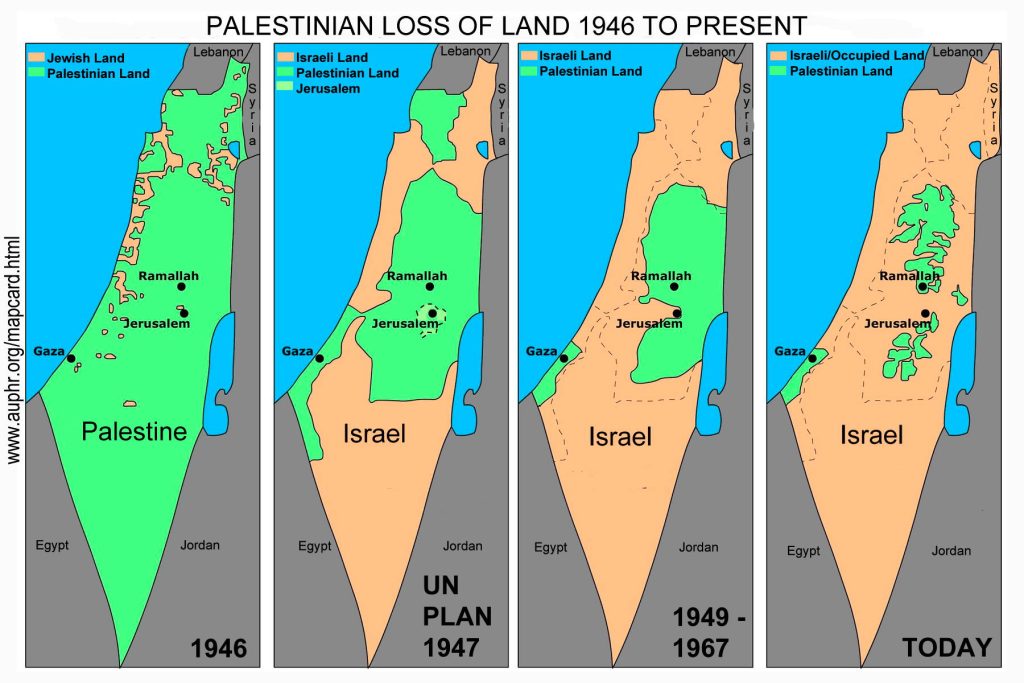
Israel, as an occupying power, is governed by United Nations international law, which clearly spells out its legal obligations and governance. Israel has, over the years, been condemned in 45 UN resolutions by the UN Human Rights Council. It has also been condemned for enabling 700,000 Israeli settlers to live in the West Bank including East Jerusalem, all in 300 illegal settlements. The Israeli army protects the settlers. More settlements are underway.
A UN Commission Inquiry in 2022, decided that Israel has dominated the areas under question for so long it could be considered an illegal act of ‘annexation’. There have been no actions taken against Israel for any violation primarily due to its protection by the U.S., and mainstream Jewish community.
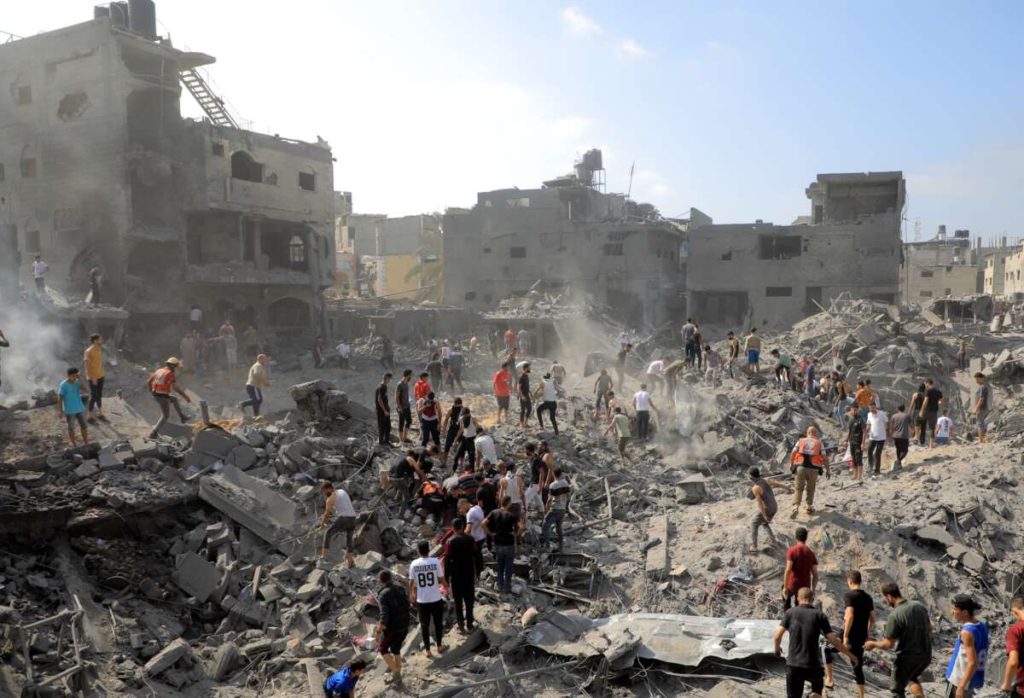
Under Prime Minister Netanyahu, Israel has conducted a war against Hamas primarily in Gaza and West Bank in response to terrorism committed by Hamas: Hamas murdered 1,200 Israelis and took 251 hostages on October 7. Israel, in retaliation, has killed well over 40,000 civilians, 16,700 children and journalists, aid workers, medical personnel as well as bombed hospitals and schools, and starved large populations in Gaza. Its response has been so brutal that its key leaders have been charged with war crimes, crimes against humanity and genocide by the International Criminal Court. The U.S. has been pressuring the ICC not to issue arrest warrants for Mr. Netanyahu.
President Biden has essentially provided U.S. approval for Israel’s conduct by supplying emergency funding for advanced F-35 aircraft, 14,000 rounds of tank ammunition, and $147 million worth of components for 155 mm artillery shells; and approval of an additional $20 billion worth of weapons. All of these actions were taken without approval from Congress.
Mr. Biden has been named in a U.S. lawsuit for enabling crimes against humanity and genocide. Antony Blinken, U.S. Secretary of State, sits at the negotiating table with Palestinians as a staunch supporter of conservative Jewish organizations such as AIPAC. He has no credibility as a negotiating partner to balance interests for peace, none.
Hamas and PLO are roadblocks to development
Hamas has been identified as a terrorist organization, and proved this nomenclature to be accurate on October 7. The PLO has been allowed to hold elections over time, albeit as an essentially puppet government shaped by Israel. They share digital surveillance, police and informants against Palestinians. All groups have received billions of dollars in aid and development money, and Hamas is purported to have $500 million invested in real estate.
Yet, both groups have been unable to build significant infrastructure and create a viable economy for Palestinians. Over 80% of Palestinians in Gaza live in poverty, and the unemployment rate is approximately 40%. Reasons for this lack of development include theft of monies, incompetence, political infighting and use of funds to secure weapons and build tunnels.
The PLO and Hamas may argue, however, that Israel’s economic blockade of Occupied Territories has severely limited access to trade; settler populations, supported by the army, have stolen land, destroyed crops and animals and the IDF has bombed ports and airports. All commerce in and out of Palestinian territories must pass through checkpoints controlled by Israel.
Hope in practice
Based on failed peace agreements, apartheid conditions, and war, it is clear that a new plan—concrete and participatory– with new actors and funds is needed to move forward. Below are points to open discussion and possibilities.
- Territory & Governance: Israel will leave the Occupied Territories, West Bank, Gaza, and parts of East Jerusalem. They will remove settler populations as they have done in the past. This will occur over an agreed upon time frame, no longer than two years. Failure to do so will result in international economic sanctions. Returned land will be used to establish a Palestinian State. Palestinians will control their own land rights. Civil rights and courts will be established. The governing body will be composed of international members for a period of 5 years, including 9 member states: U.S., Israel, elected Palestinian representatives and 5 additional members, including 2 from Europe, 3 from the Middle East.
- Funding: An initial $20 billion will be invested for development of infrastructure, food distribution, housing, farming, schools and light manufacturing, and thereafter, each year for 3 years. Funding will be provided by key member states, and administered by a sub-group of the newly established international government. Monies will be used to directly fund projects, with not more than $15 million used for administration fees each year for 5 years. All funds will be released on a performance basis only. Local populations will be employed to the extent possible. Completion bonds will be issued and backed by the U.S.
- Development plans: Plans to develop the new Palestinian state will be participatory in content and execution. District groups and participatory methods will be used to present plans for houses, infrastructure, shopping areas, schools and medical clinics. Payments for individual participation in all aspects of planning will be made. The first plans will include food production and distribution, as well as medical and psychological clinics.
- Psycho-social healing: Psychological teams, foster and extended families must be set up and supported to address trauma caused by war.
- Truth and reconciliation: Identified leaders on both sides, and IDF will be identified and tried by a separate group of judges. The format and procedures used at Nuremberg will be employed. The group will have legal standing in the international community beyond local and national influences.
- Interface with Israel: All checkpoints entering Israel will be eliminated except those that accommodate commercial and personal traffic directly. A new system of governance, commerce, and the elimination of terrorist threats must be established. All electronic surveillance of Palestinians everyday life must be withdrawn. Aerial surveillance will be enacted for control over airspace and weapons as well as below surface monitoring of tunnels. Entrance to Israel will be accomplished primarily by use of selected roads and sea, pre-approved, and not unduly withheld.
- Commerce: All commerce will be conducted by major roads and sea, except where pre arrangements are made to initiate and complete transactions. All transportation into Israel will be monitored by cameras and personnel to ensure safety. A Palestinian airport and port will be redeveloped.
- Right of Return: Palestinians will be eligible for the right of return, not to exceed 250,000 annually for the first three years. This will allow for orderly assimilation and accommodations.
Conclusion
In order to create a different future for Israel and Palestine, we must change leadership, representation, methods of participation and governance. We must heal hatred and adjudicate those parties responsible for crimes against humanity on both sides. So far, everyone’s actions in positions of power have resulted in poverty and death. Promoting genuine peace and prosperity can be accomplished by consulting what’s worked in other horrendous situations and adapting plans and strategies to the challenges at hand. Solutions depend on the political will to begin the process of healing based on case histories of success, adopted for this unique culture, time and place.